
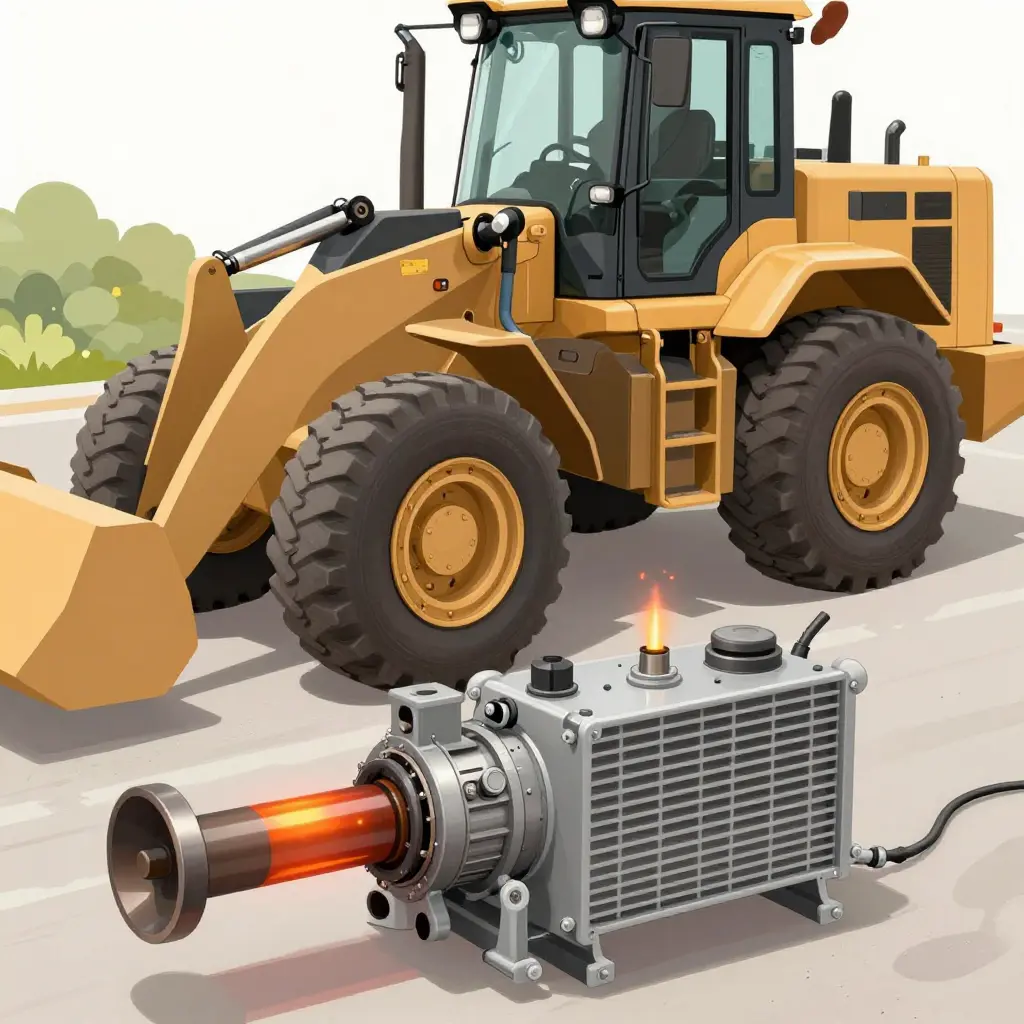
Wheel Loader Torque Converter Overheating: Stall Test vs Clogged Oil Cooler
Run a wheel loader through constant bucket cycles and transmission oil temperature will climb. When it passes the safe operating band, the cause usually comes down to one of two things: a torque converter that has failed, which a stall test will confirm, or a clogged oil cooler that is throttling fluid flow. Both faults generate heat, but they call for opposite repairs. Identify the real source before anyone orders parts.
The symptoms overlap, and that is where diagnosis goes wrong. A slipping converter and a restricted cooler can both push a loader into derate, darken the fluid, and light the same warning lamp on the dash. Replace the converter when the cooler is actually clogged and the heat simply moves to a new component; the overheating comes back on the next shift.
The two failure mechanisms are compared below, along with how a stall test separates them and which order of checks saves the most service hours.
How a Wheel Loader Torque Converter Generates Heat
A wheel loader sends engine power to the wheels through a torque converter, a fluid-filled device that stands in for a mechanical clutch. It links engine to transmission through moving oil rather than gears, and that is why the converter produces heat by design.
Three parts do the work. The impeller (pump) bolts to the engine flywheel and spins at engine speed, throwing oil outward. The turbine sits opposite it, catches that oil, and drives the transmission input shaft. Between them, the stator rides on a one-way clutch and redirects oil leaving the turbine so it re-enters the impeller in the direction of rotation. That redirection is where torque multiplication happens: the stator adds a push to the engine’s effort, which is what lets a loader dig into a pile with more force than the engine alone provides.
Why the Oil Gets Hot
Whenever the impeller and turbine spin at different speeds, energy leaves the system as heat. The extreme case is the stall condition: the wheels and turbine are held still while the engine keeps spinning the impeller. With the turbine locked, almost all the mechanical energy going into the fluid becomes heat instead of useful work.
Temperature climbs fast:
- At full stall, turbine speed drops to zero while the impeller churns the fluid at full engine RPM.
- The churning oil absorbs mechanical energy as friction and converts it into heat, not motion.
- Sustained stall can push oil temperatures past safe limits within seconds.
How the Heat Escapes
The heat has to go somewhere. A pump circulates oil through the converter and out to a transmission oil cooler, usually a liquid-to-liquid or air-cooled exchanger near the radiator. The oil sheds heat there before returning to the lubrication circuit, which also feeds bearings, clutch packs, and gears. Normal transmission oil temperature sits around 180°F to 220°F (about 82°C to 104°C). Readings above that range usually mean a clogged cooler, a worn converter, or an operator who stalled the machine too long.
Knowing that cycle tells you whether the heat is a real fault or just how the loader is being used.
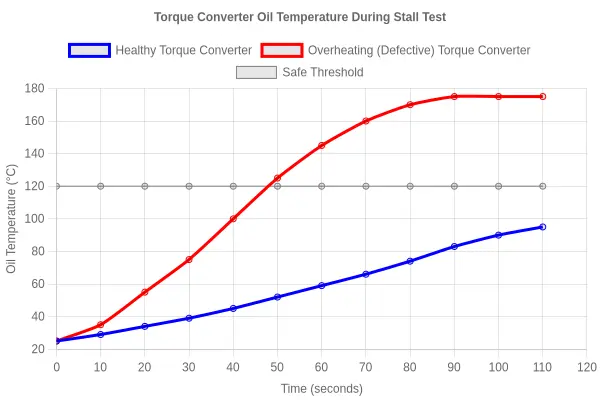
The healthy converter’s temperature climbs gently and stays under the 120°C threshold. The defective converter’s temperature rises sharply and crosses it in well under a minute — a sign that the converter itself, not just a clogged cooler, is driving the overheat.
The Stall Test: Purpose and Procedure
A torque converter stall test is a stationary diagnostic. With the service brakes fully applied, the operator holds full throttle in a designated gear while the machine stays put. The output cannot rotate, so the turbine stops and the pump and engine load against the fluid coupling. The engine settles at a fixed maximum speed called the stall speed.
That one measurement shows three things:
- Engine RPM drop — how much the engine slows when loaded against the converter.
- Converter slip — the difference between pump and turbine speeds under full load.
- Heat buildup — how fast transmission oil temperature rises during the test.
Safe Test Conditions
Test only when all of the following hold:
- The machine is on level, firm ground, clear of traffic and obstructions.
- Service brakes and parking brake are fully functional and can hold the loader.
- Transmission oil is at operating temperature, typically 80-95 C (176-203 F). Cold oil produces falsely high stall speeds.
- Ambient temperature is recorded, along with any recent converter or cooler repairs.
Procedure
- Warm the machine by operating normally until transmission oil reaches 80-95 C.
- Park on level ground, apply the parking brake, and fully depress the service brake pedal.
- Select the specified test gear, usually second or third, as stated in the service manual.
- Raise engine speed to full throttle in one smooth motion and hold it steady.
- Read and record the maximum engine RPM within about 5 seconds; do not hold any longer.
- Release the throttle immediately, then release the brakes.
- Let the machine idle and cool while you monitor oil temperature.
Interpreting the Readings
Compare the recorded stall speed against the manufacturer’s specification. An abnormally low stall speed points to a restricted converter, low charge pressure, or a worn engine that cannot develop the expected torque. Oil temperature that climbs rapidly during the test means the converter is making too much heat, which may be internal wear or, more often, a clogged oil cooler that cannot dissipate it. When temperature rises quickly while stall speed stays near spec, check the cooler circuit first. This is what lets the stall test separate a converter fault from a cooling fault before any teardown.
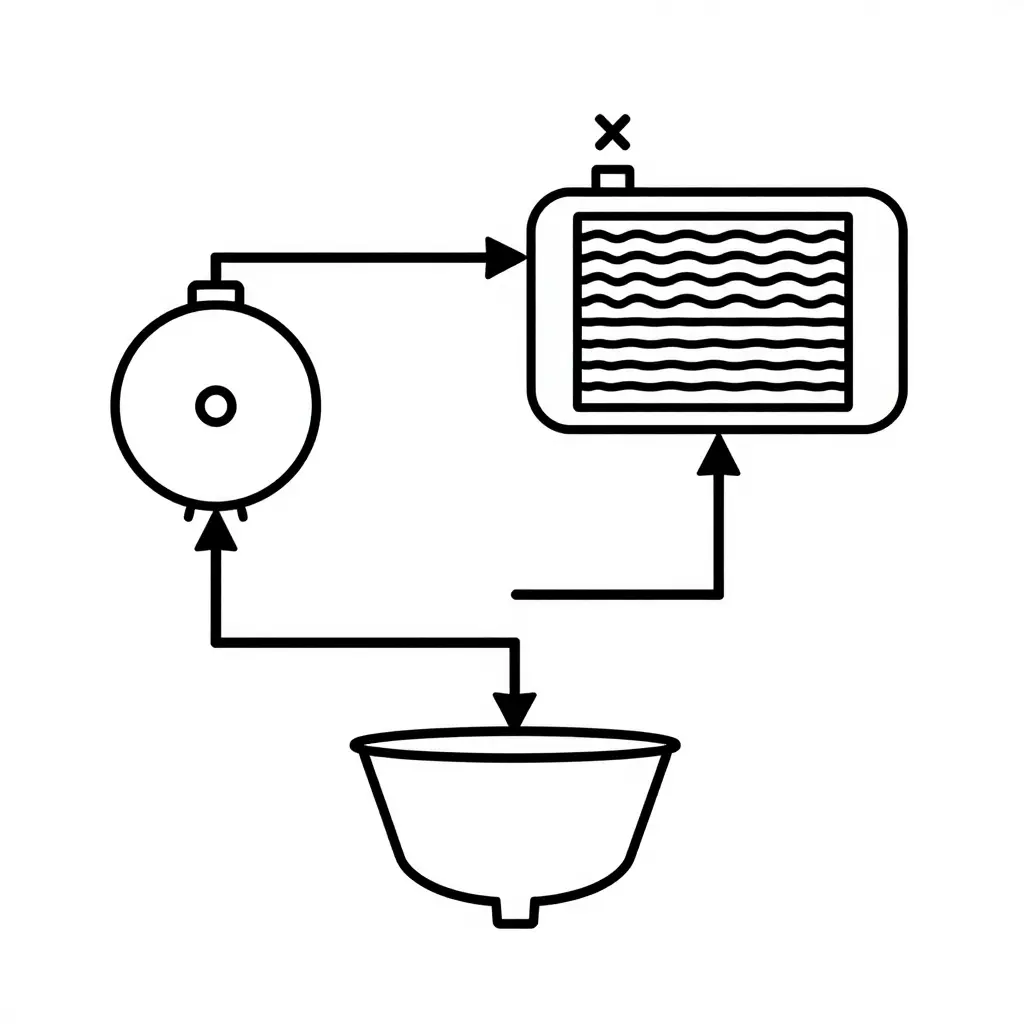
The oil circuit above runs from the converter up to the transmission oil cooler, down into the sump reservoir, and back to the converter. Follow the arrows and a single restriction — the blockage marked at the cooler inlet — backs hot fluid up through everything downstream. That is exactly the condition that shows up as a clogged cooler rather than a converter fault.
Clogged Oil Cooler Symptoms and Root Causes
A wheel loader’s torque converter needs a continuous, clean supply of transmission fluid to carry heat away from the fluid coupling. Oil circulating normally moves the heat from fluid shear and stall loads to the cooler, which releases it through the cooling system. Clog the cooler and that heat has nowhere to go; converter temperature climbs within minutes of sustained hard work.
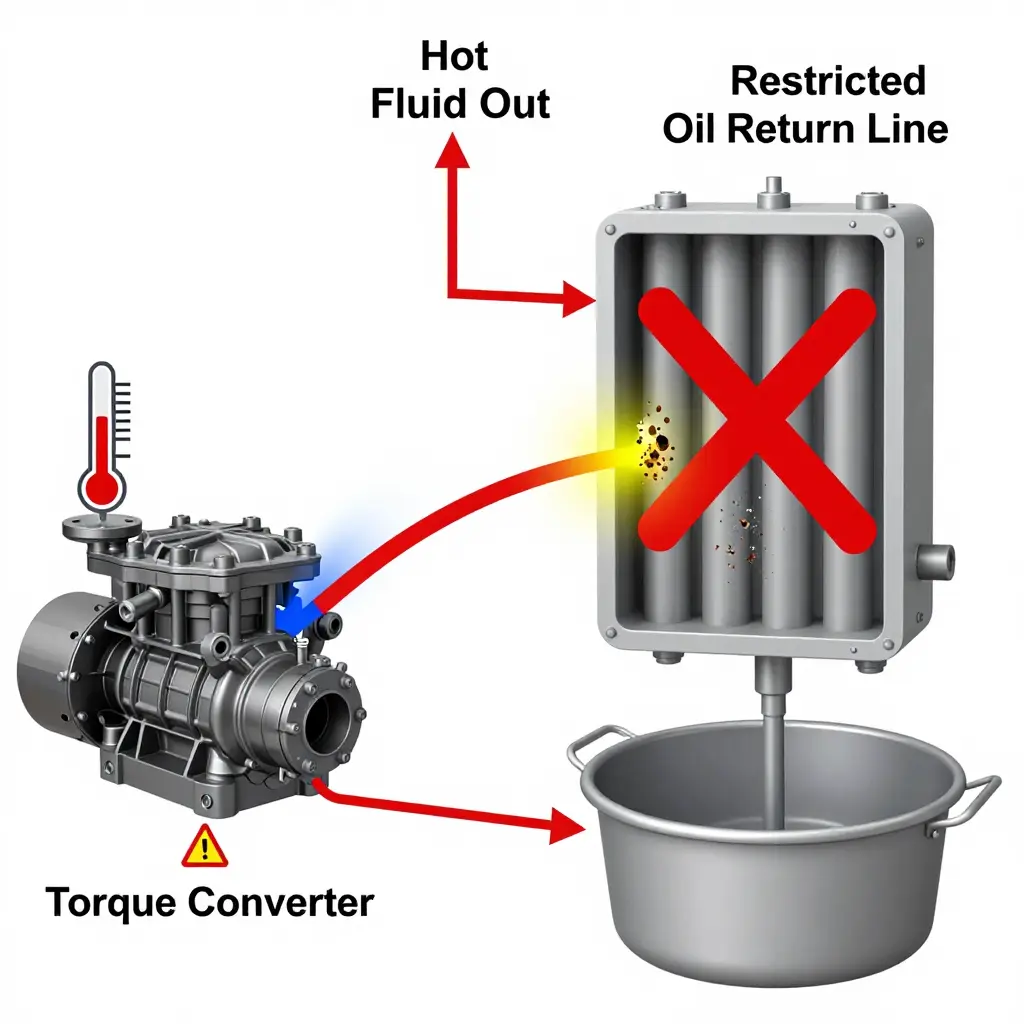
The Flow Path and Why It Matters
In most circuits, hot fluid leaves the converter, passes through the oil cooler, and returns to the transmission sump. That loop keeps temperatures stable, and a clog keeps it from closing. Restricted flow forces the same heated fluid to recirculate, so cooling capacity drops and converter temperature rises. The hotter the fluid gets, the thinner and less protective it becomes, which speeds wear and generates still more heat.
Internal and External Causes of Restriction
Restrictions start inside the cooler and around it. Clutch debris, metal particles, and sludge narrow the passages from within; airflow and coolant contact fail from without.
Causes worth tracking:
- Internal debris and sludge — clutch material and metal shavings settle in cooler tubes, narrowing the passages over time.
- Degraded transmission fluid — oxidized or contaminated fluid forms varnish that coats internal surfaces.
- Bent or packed fins and contaminated coolant passages — damaged fins or fouled coolant channels cut heat transfer.
- A restricted return line — a kinked or blocked hose limits flow back to the sump, backing up the entire circuit.
Symptoms Owners and Managers Will Notice
Early signs are a rising temperature on the gauge, delayed or sluggish shifting, and a hot, burnt smell from the fluid, which often looks dark and discolored. Loaders frequently derate or lose pushing power under load. As the problem advances, warning lights come on and the machine may stop moving entirely.
Clogged Cooler vs Converter-Internal Faults
A clogged oil cooler raises temperature because heat cannot leave the circuit, even though the converter itself may be mechanically sound. Converter-internal faults behave differently. A failing stator, a worn one-way clutch, or a damaged turbine produces poor stall performance, low torque multiplication, and abnormal noise regardless of fluid temperature. Cooler restrictions are heat-removal problems. Converter faults are mechanical power-transfer problems.
| Diagnostic Dimension | Stall Test Findings (Converter-Internal Failure) | Clogged Oil Cooler Symptoms |
|---|---|---|
| Oil temperature behavior | Spikes fast during stall, cools slowly afterward | Climbs gradually under load, stays hot after stall |
| Pressure readings | Converter inlet and outlet pressures fall below spec | High cooler inlet pressure, weak or low outlet flow |
| Engine RPM behavior | Stall RPM off spec (high or low) at full stall | Normal stall RPM, sags under sustained load |
| Fluid condition | Dark, burnt fluid with metallic debris and varnish | Dark fluid but little metal, sludge in cooler core |
| Noise or vibration | Whine, rattle, or shudder from the converter housing | Little internal noise, hot cooler lines and surging |
| Required corrective action | Rebuild or replace the torque converter | Flush or replace cooler and lines, restore flow |
Torque Converter Overheating Diagnostic Checklist
Work through these checks in order to isolate converter slip, insufficient cooling flow, or a clogged oil cooler.
- Verify the overheating under real working load using the transmission temperature gauge and a calibrated pyrometer, and confirm the reading stays below the normal band at idle (a reading that normalizes at idle but climbs under sustained bucket or bucket-fill loading points to a load-dependent slip or cooling-flow fault, not a sensor error).
- Check transmission fluid level with the engine idling, at operating temperature, machine level on firm ground, after cycling through every gear range (a low level invites aeration and pump cavitation, while an overfull sump churns the oil into foam that both aerates and overheats).
- Sample fluid condition by dropping a few ounces onto a clean white cloth (dark, varnished, or burnt-smelling fluid with a charred odor indicates clutch or converter-clutch slippage already generating excess heat; a metallic sheen signals internal wear debris).
- Measure converter-outlet temperature with an in-line sensor or infrared gun on the cooler feed line (an outlet temperature above roughly 120 degrees C / 248 degrees F while the sump stays moderate confirms the converter itself is acting as the heat source).
- Log the temperature rise across the converter by comparing converter-in and converter-out readings (a differential greater than about 30 degrees C / 54 degrees F signals excessive slip inside the unit).
- Gauge converter charging and main relief pressure at the designated test ports (low charging pressure starves the converter of cooling flow and promotes cavitation-driven heat buildup).
- Measure the pressure differential across the oil cooler by reading inlet versus outlet pressure on the cooling loop (an elevated drop reveals internal core restriction or sludge limiting heat rejection).
- Observe oil return flow from the cooler back to the sump or tank (a weak, pulsing, or intermittent return stream confirms a clogged cooler core or a stuck cooler bypass valve).
- Run a controlled stall test and compare the recorded stall speed against the OEM specification (a stall speed well below spec implicates the converter stator or one-way clutch, while an abnormally high stall speed points to slipping clutches or low system pressure).
- Confirm the engine cooling package is not the real culprit by checking fan operation, thermostat function, and radiator airflow (if engine coolant is also running hot, the overheating may originate in the cooling system rather than the torque converter).
Order matters here. Verifying fluid level and condition first clears the cheapest and most common causes before you spend time on pressure and stall testing. Authorize converter removal only after cooling flow and converter slip have both been ruled out.
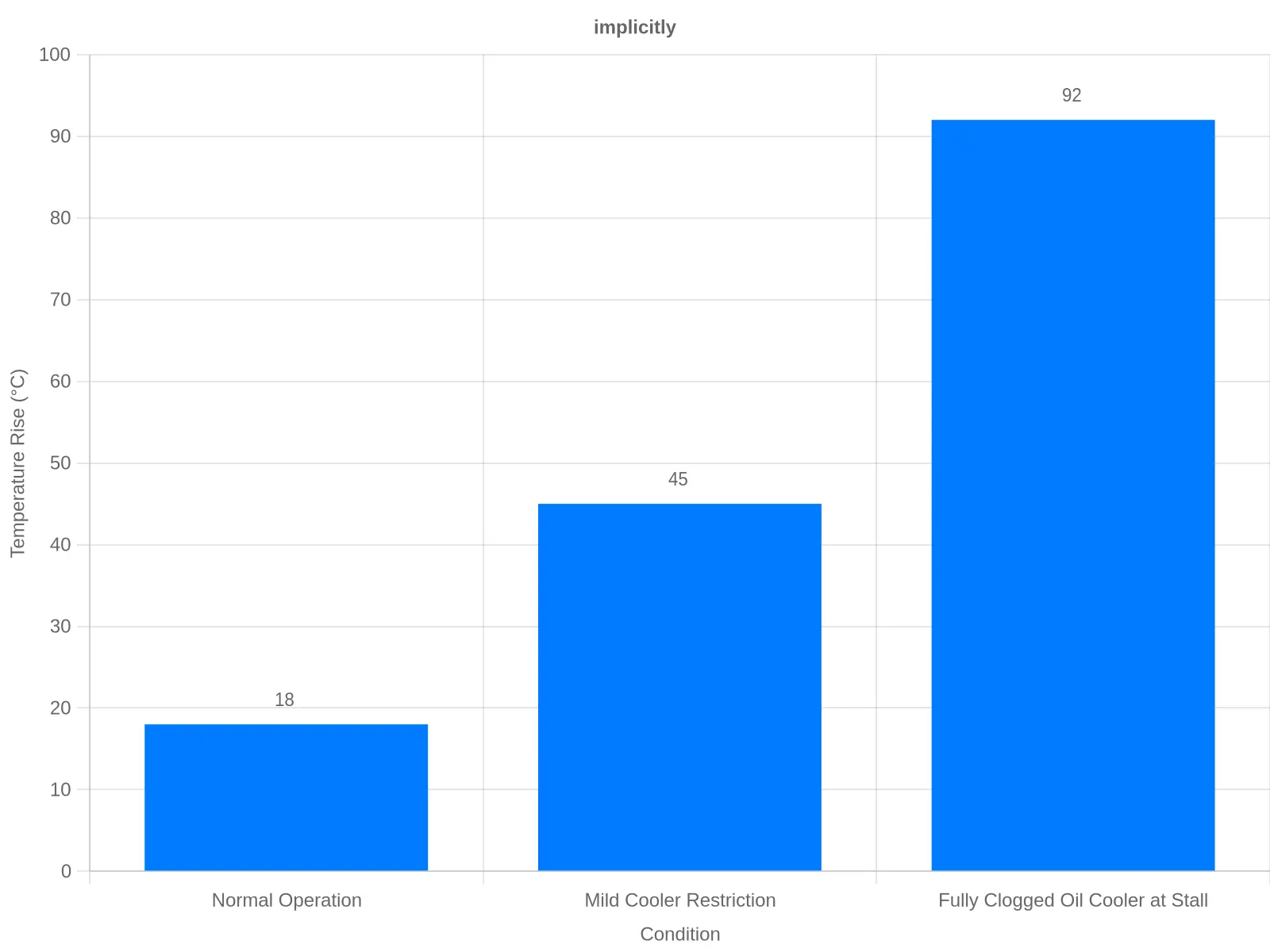
Peak oil temperature rise climbs sharply as cooler restriction worsens, from 18°C under normal operation to 92°C when the oil cooler is fully clogged at stall — more than five times the healthy baseline.
Distinguishing the Two Root Causes
Overheating traces to one of two explanations: an internal torque converter fault or a clogged oil cooler restricting flow. The symptoms look alike, so the goal is to separate them with a repeatable diagnostic sequence rather than guesswork.
Start with the stall test, which isolates the converter. The engine is held at full throttle against a locked drivetrain while you record stall speed and temperature rise. A stall speed outside the manufacturer’s range, paired with a rapid temperature climb, indicates an internal converter problem — a slipping stator clutch, a worn turbine, or a failed one-way clutch. If stall speed and heat rise stay within spec, the converter is probably healthy, and you should look downstream instead.
Once the converter is cleared, verify the cooler circuit. A clogged oil cooler restricts return flow, so converter fluid has nowhere to shed heat. Check the inlet-versus-outlet temperature differential and the pressure drop across the cooler. A large temperature drop with low outlet flow confirms a restriction, whether from debris, sludge, or a collapsed internal passage.
The diagnostic sequence
- Run the stall test and compare stall speed plus temperature rise against spec. Off-spec results rule converter-internal faults in.
- If the stall test passes, measure cooler flow and pressure drop to confirm or rule out a clogged oil cooler.
- Reconcile both results before concluding. Treat any case where both tests are borderline as ambiguous.
Resolving ambiguous cases
Ambiguity usually appears when the stall test is marginally high and cooler flow is only slightly reduced. Do not commit to a single cause. Flush and inspect the cooler first, since that is the cheaper repair, then repeat the stall test. If overheating persists after flow is restored, the converter is the remaining suspect. Documenting both measurements side by side keeps the decision traceable and avoids replacing a healthy converter or overlooking a partially blocked cooler.
Maintenance and Prevention: Keeping Torque Converter Heat Under Control
Overheating rarely arrives without warning. It is usually the slow result of degraded fluid, a fouled cooler, or a filter that stopped doing its job. Treating wheel loader maintenance as a routine habit rather than a reaction to a warning light is what keeps transmission temperatures in a safe band.
Fluid Quality and Change Intervals
Torque converter fluid is the working medium and the coolant at the same time. It transfers torque, lubricates bearings, and carries heat out to the cooler. As it ages, its viscosity breaks down and its additives deplete, so it can no longer carry heat efficiently.
Follow the OEM interval, but shorten it in dusty, high-load, or hot climates. Under heavy duty cycles, sampling the fluid for wear metals and oxidation tells you more than a fixed calendar ever will.
Cooler Flushing and Cleaning
The oil cooler is where heat actually leaves the system. External fins pack with dust and debris, and internal passages collect varnish and sludge. Blow out the fins regularly and flush the cooler circuit during major services. A partially clogged cooler forces the converter to run hotter at every load.
Filtration
Keep both the suction screen and the full-flow filter clean. A restricted filter drops oil flow, and low flow means poor heat removal. Replace filters on schedule and inspect the captured debris for metal particles, which signal internal wear before it becomes a failure.
Monitoring Oil Temperature During Heavy Duty Cycles
Real-time transmission oil temperature monitoring lets operators catch a rising trend before it turns into a breakdown. Watch the gauge during sustained loading, long climbs, and repeated stall conditions. If the temperature climbs steadily, stop and cool down rather than pushing through the cycle.
Preventive Actions
- Check fluid level and color at every shift start.
- Sample fluid at set intervals for wear metals and moisture.
- Clean cooler fins with low-pressure air or water.
- Flush and inspect the cooler circuit at major service.
- Replace filters on the OEM schedule and inspect for debris.
- Watch transmission temperature during peak load.
- Allow a cool-down idle before shutdown after heavy work.
Modern equipment engineering builds some of this protection into the machine. Zoomlion, a dual-listed equipment manufacturer founded in 1992, designs cooling and monitoring systems intended to hold transmission oil temperature stable even through demanding duty cycles.
That engineering still depends on disciplined upkeep. Clean fluid, clear coolers, and vigilant temperature monitoring prevent most overheating long before a stall test or a cooler replacement becomes necessary.
Wheel Loader Torque Converter Overheating: Stall Test vs Clogged Oil Cooler
A hot-running torque converter sends maintenance teams in two completely different directions. On one loader the fault is a worn converter that a stall test exposes in minutes. On the next machine the converter is perfectly healthy, and the real trouble is a clogged oil cooler that has quietly choked off the circuit’s ability to shed heat. Both conditions look almost identical on the temperature gauge, yet the repairs are worlds apart.
This walkthrough breaks down what each test actually tells you, how to separate the two faults, and what owners and operators do to keep the problem from coming back.
Why Torque Converters Run Hot
A wheel loader’s torque converter is a hydraulic coupling filled with transmission fluid. It multiplies engine torque and, in doing so, converts a great deal of mechanical energy into heat. Under normal duty the transmission oil cooler keeps fluid within a healthy band — roughly 180 F to 220 F (82-104 C). Push past about 250 F (121 C) and the fluid begins to oxidize, seals harden, and the clutch packs in the adjoining transmission start to suffer.
Two very different failures can drive those temperatures up:
- A mechanically failing converter (a slipping stator, internal leakage, or worn internals)
- A restricted oil cooler that cannot reject heat fast enough
The Stall Test: Measuring Converter Health Directly
A stall test measures the maximum engine speed the converter can hold when the output is locked. It is the quickest way to separate a converter problem from a cooling problem.
- Warm the transmission fluid to operating temperature.
- Chock the wheels and set the parking brake.
- Apply the service brakes firmly.
- Shift into forward, hold full throttle for no more than 5 seconds, and record the peak (stall) speed.
- Repeat in reverse, allowing the fluid to cool between runs.
| Observed Stall Speed | Most Likely Cause | Next Step |
|---|---|---|
| Below specification | Worn converter or low engine power | Inspect converter; verify engine |
| Above specification | Slipping stator or clutch pack | Internal transmission diagnosis |
| Within specification | Converter healthy | Investigate the cooling circuit |
If the converter stalls within spec and the machine still overheats, the converter is probably not your villain — and that points straight at the cooling circuit.
Clogged Oil Cooler: The Restriction You Can’t See
The oil cooler is a heat exchanger that relies on clean internal passages, steady airflow, and correct coolant flow. Scale, sludge, debris, collapsed hoses, or a failed thermostat can all restrict it. The result is a converter that keeps making heat while the cooler quietly refuses to remove it.
Watch for these clues:
- Heat builds at light load rather than under heavy digging
- A small temperature drop across the cooler inlet and outlet
- Fluid that darkens or smells burnt long before its service interval
Confirm the diagnosis with a contact thermometer across the cooler, a flow test, and a pressure differential reading. A cooler showing almost no temperature drop under load is starving the circuit, not cooling it.
Stall Test vs Clogged Cooler: A Side-by-Side
| Diagnostic Clue | Failing Converter | Clogged Oil Cooler |
|---|---|---|
| Stall speed | Out of specification | Usually normal |
| Heat pattern | Rises under heavy load | Rises even at light load |
| Fluid condition | Burnt, darkened | Burnt, darkened |
| Cooler delta-T | Normal | Reduced |
| Best fix | Converter rebuild/replace | Cooler flush/replace |
Maintenance Habits That Prevent Recurrence
Prevention beats diagnosis every time. Build these routines into your service schedule:
- Sample transmission fluid at every oil change and track the trend
- Flush the cooler on a fixed interval, not only when it fails
- Replace filters on time and inspect for metallic debris
- Clean the radiator and cooler fins so airflow stays unobstructed
- Log stall speed for each machine so you spot drift early
Ownership: Planning for Downtime Before It Happens
Owning or managing a fleet is a balancing act between uptime, budget, and the people who keep the machines running. Heat-related failures rarely pick a convenient moment; they tend to arrive mid-project, on a Friday, with a deadline looming. The owners who cope best plan for downtime instead of reacting to it: a shelf stocked with spare coolers and filters, a documented stall-test baseline for every loader, and a clear escalation path when temperatures climb.
Operator Resources & Training
Beyond parts and procedures, a solid resource library keeps operators and owners on the same page. Factory service manuals, lubrication charts, and coolant specifications belong in every cab and every office, and new operators should be walked through the stall-test procedure before they ever need it in anger.
Final Thoughts
Torque converter overheating almost always traces back to one of two paths: a converter that has genuinely failed, or a cooler that has quietly stopped doing its job. The stall test tells you which path you are on in a matter of minutes, and a temperature check across the cooler confirms it. Diagnose first, repair once, and keep the fluids, filters, and fins in shape.
Frequently Asked Questions: Wheel Loader Torque Converter Overheating
How can I tell whether the heat is coming from the converter or the oil cooler?
When wheel loader torque converter overheating appears, the source matters because the repair is completely different. Measure the oil temperature at the sump and again at the cooler return line. If the return line is still hot, the cooler is not rejecting heat, which points to an oil cooler restriction. If the sump runs hot even with a clean, free-flowing cooler, the converter itself is slipping and creating the heat internally.
Why is a stall test different from diagnosing a clogged oil cooler?
A stall test measures converter performance under a controlled full-throttle, zero-motion load. You compare stall test results (engine rpm and the temperature rise) against the OEM specification to judge whether the turbine, stator, and impeller are working correctly. A clogged oil cooler, by contrast, is a flow and pressure problem, so you diagnose it with temperature differentials and pressure drop across the cooler rather than with stall speed.
What is a safe oil temperature range for a torque converter?
Most heavy equipment torque converters run best between roughly 180°F and 220°F (82°C-104°C) during normal operation. Sustained temperatures above about 250°F (121°C) accelerate oil oxidation and seal damage, while brief spikes near 300°F call for an immediate shutdown. Always confirm the exact limit in your machine’s service manual, because the threshold varies by transmission model and oil specification.
Can a clogged oil cooler mimic a failing torque converter?
Yes, and this is one of the most common diagnostic traps. A severe oil cooler restriction reduces oil flow, raises sump temperature, and can make the converter shudder or lose efficiency, producing symptoms that look identical to internal converter failure. Before condemning the converter, always verify cooler flow and pressure drop to rule out a restriction first.
How often should the oil cooler be flushed?
Flush the transmission oil cooler whenever you change the transmission oil and filters, or at the interval in your service manual, which is typically every 1,000 to 2,000 operating hours. You should also flush after any converter or transmission rebuild, because debris from a failure will contaminate the cooler and cause repeat overheating. On machines in dusty conditions or high-duty-cycle work, shorten that interval.
What should I check first when the temperature spikes?
Start with the basics: oil level and oil condition, then inspect the cooler and its lines for external blockage, bent fins, or internal restriction. Confirm the cooling fan and thermostat are working and check for a collapsed or kinked return hose. Only after ruling out low oil, poor airflow, and an oil cooler restriction should you move on to a stall test to evaluate the converter itself.
The Bottom Line: Test First, Replace Second
A stall test does not diagnose a clogged oil cooler on its own. It tells you whether the torque converter is building the pressure and heat it should. When the test results come back within specification for your machine model and the transmission fluid still reads abnormally hot, the cooler circuit becomes the prime suspect. When stall test numbers fall short, the converter, pump, or valve body deserves the first look. The test is a compass, not a verdict.
The reliable sequence stays the same: confirm the complaint with a temperature reading under load, perform the stall test to rule the converter in or out, then inspect the oil cooler and lines for restricted flow, debris, or coolant-side fouling. Only after that chain of evidence points to a component should any part come off the machine.
This discipline matters because wheel loader torque converter overheating often traces back to something as simple as a partially blocked cooler that a converter replacement would never fix — an expensive miss. For owners, managers, and engineers, the practical takeaway is direct: let the stall test narrow the field, verify the cooler before you condemn the converter, and replace parts only when the data says so. Diagnose first, spend second.
- Test before you guess. Use the stall test to separate converter faults from cooling-circuit faults.
- Follow the sequence. Temperature check, stall test, cooler inspection — in that order.
- Confirm the root cause. Replace only the component the evidence identifies, not the most likely suspect.