
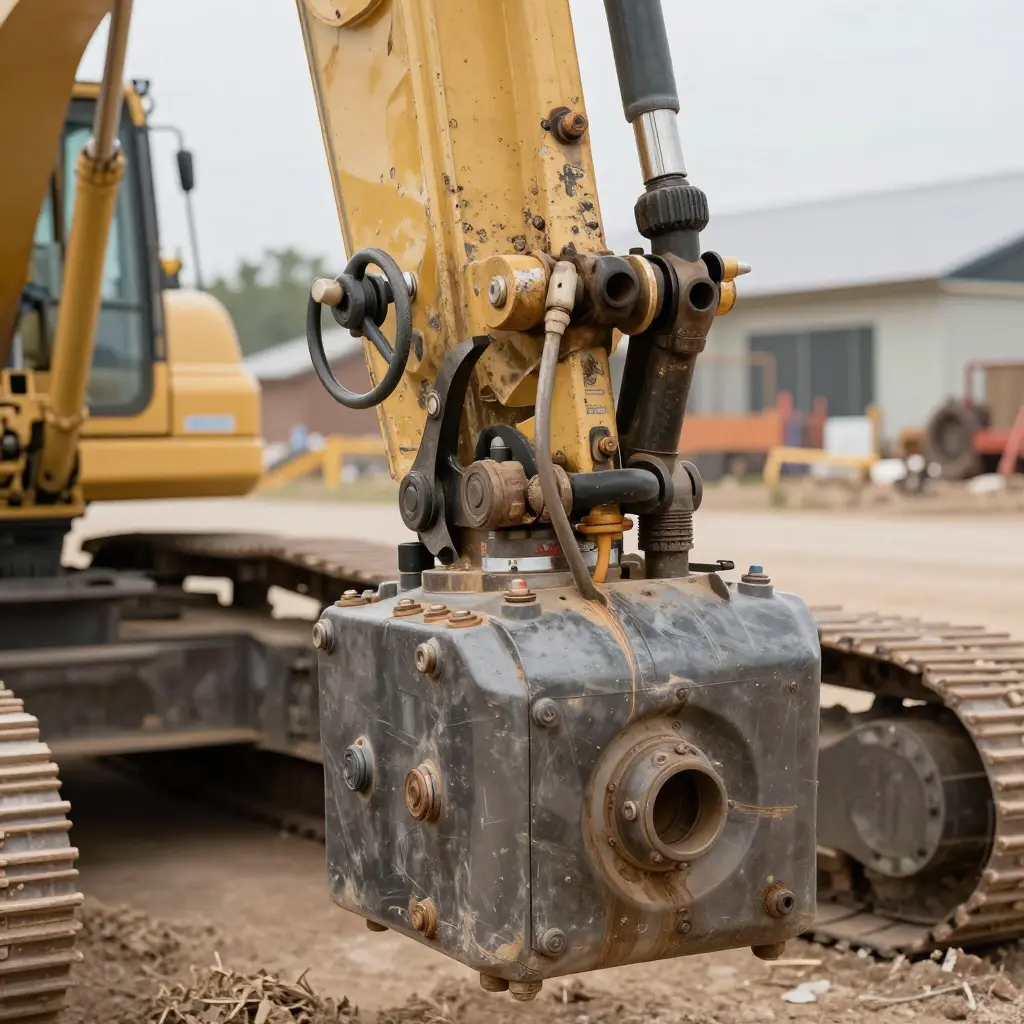
Why Excavator Boom Cylinders Drift: A Common Hydraulic Fault
Boom cylinder drift is the slow sag or creep of the boom when the machine is supposed to hold a load in a fixed position. An operator sees it as a gradual drop over several minutes, or as a boom that settles the instant the control lever returns to neutral. On any hydraulic excavator, it means pressure is escaping somewhere in the boom circuit.
Two faults cause the large majority of drift complaints: internal leakage inside the boom cylinder, and wear in the control valve section that governs boom raise. Internal leakage lets pressurized oil bypass the piston seal and escape through the cylinder’s internal passages. Valve wear lets oil slip past a spool that no longer seals tightly in its bore, so the boom bleeds down even when the cylinder itself is sound.
From the operator’s seat the two look nearly identical, which is why so much diagnostic time goes into replacing the wrong component. It pays to know the tests that separate them before money goes to parts. The sequence below works on any excavator in a fleet, whatever the brand or age.
How a Boom Cylinder Holds a Raised Load
The boom cylinder is the hydraulic cylinder that raises and lowers the boom. With the machine parked and the boom up, its job is not to move the load but to resist gravity and keep the boom where the operator left it. Three things make that possible: pressurized fluid, sealed chambers, and a valve that traps the pressure.
Oil is the working medium. Because it is nearly incompressible, fluid trapped in the cylinder acts like a solid column that transmits force. On the bore side (the full-area chamber beneath the piston), pressurized oil pushes the rod outward and carries the weight of the boom and any attached load. The rod side (the smaller annular chamber around the rod) holds oil against the opposite face of the piston. The difference in surface area between the bore side and the rod side is what lets the cylinder generate and hold lifting force.
The piston and rod seals keep the two chambers separate. Piston seals sit between the piston and the cylinder wall and stop oil crossing from the high-pressure bore side to the rod side. Rod seals sit where the rod exits the barrel and stop oil escaping to the outside. Together they contain the fluid so force can build and hold.
A closed-center control valve completes the circuit. With the lever centered, the spool blocks the ports that connect the cylinder to the pump and tank. No open path out of the loaded bore chamber means oil cannot flow back to the reservoir, so pressure stays trapped and the boom holds its position.
Drift begins when that trapped oil escapes through one of two paths:
- Past the piston seals (internal leakage). Worn or damaged piston seals let high-pressure oil slip from the bore side to the rod side, where it can return to tank. The load sinks slowly because the seal is no longer a reliable barrier.
- Past the valve spool (control valve wear). A worn spool or scored bore in the closed-center valve lets oil leak from the cylinder port to the tank port even with the valve centered. The oil bleeds off and the boom creeps down.
Key Hydraulic Components Involved
- Hydraulic fluid – the near-incompressible oil that transmits and holds force.
- Bore-side chamber – the full-area chamber that supports the load.
- Rod-side chamber – the smaller annular chamber on the opposite face of the piston.
- Piston – the moving divider between the two chambers.
- Piston seals – the barrier that stops oil leaking across the piston.
- Rod seals – the barrier that stops oil leaking out around the rod.
- Closed-center control valve – the spool valve that traps pressurized oil when centered.
Holding therefore depends on trapped fluid and two sealing points, and either one can fail.
Internal Leakage in the Boom Cylinder
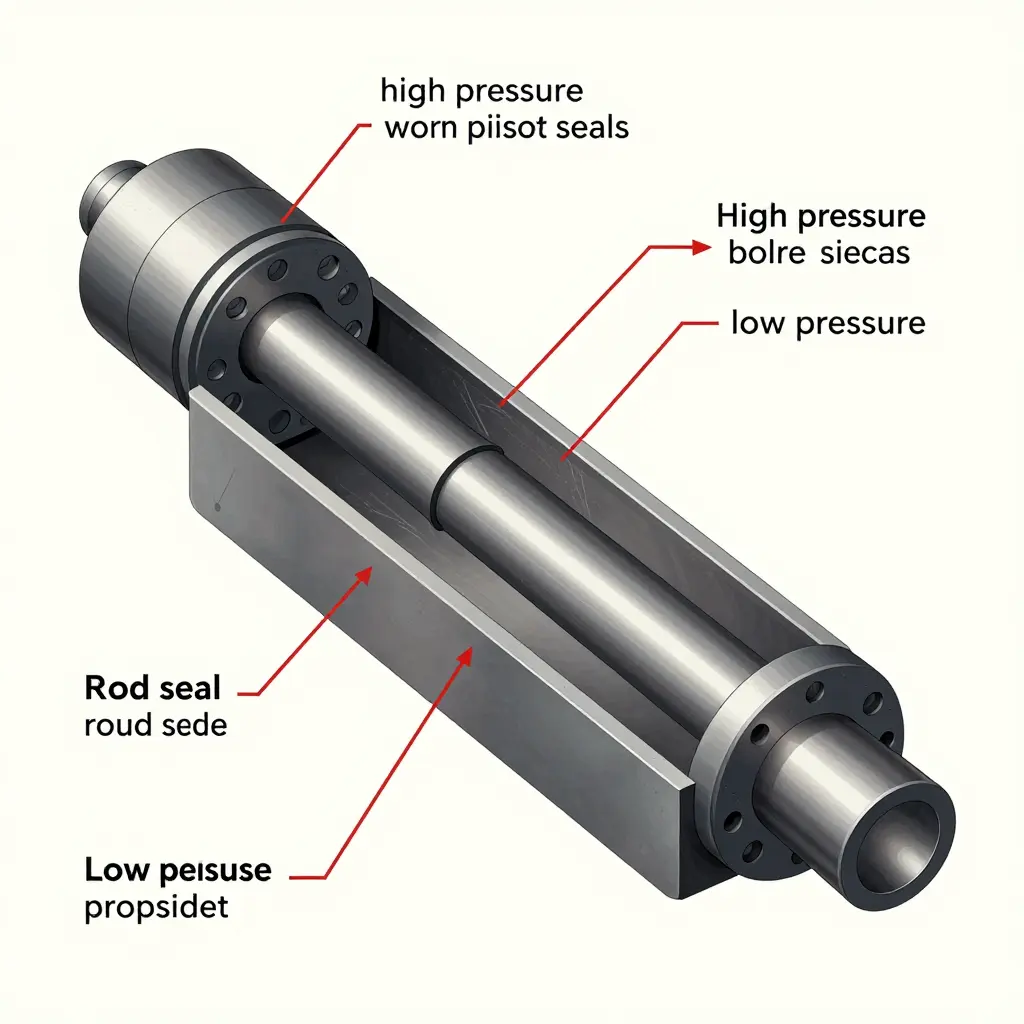
Internal leakage is one of the most common mechanical causes of boom cylinder drift. Hydraulic fluid bypasses the piston inside the cylinder, moving from the high-pressure bore side to the low-pressure rod side without doing useful work. Because the oil never reaches the ground, the fault is often invisible from outside the machine.
How Worn Seals Create Hydraulic Fluid Bypass
The piston separates two chambers: the bore side (cap end, high pressure) and the rod side (low pressure). Piston seals, rod seals, and the cylinder bore itself form the sealing boundary that holds the boom in place. When piston seals wear, harden, or tear, oil slips past them and equalizes pressure between the two sides. A scored or scratched cylinder bore allows the same bypass even when the seals are still serviceable. Holding force drops, and the boom creeps down under its own weight and the attached load.
Contributing Factors
A few conditions speed up seal wear and bore damage, and they usually act together rather than alone.
- Contamination: abrasive particles in dirty or degraded oil act like sandpaper on seals and bore surfaces.
- High oil temperature: heat softens and ages seals faster, reducing their elasticity and grip.
- Normal seal aging: seals harden and shrink over time, so even a clean machine eventually loses sealing performance.
- Bore scoring: scratches, rust, or trapped metal debris carve channels that let oil bypass the seals entirely.
How Internal Leakage Behaves
Internal leakage usually worsens as load and heat increase. A cold machine may hold its position; once the oil thins at operating temperature, the drift gets faster and more uneven. The movement is typically slow and inconsistent rather than a sudden drop.
The fault usually produces no visible external oil loss. There is no puddle under the machine and no damaged hose, because the oil recirculates inside the cylinder instead of staying where it should.
Indicators of Internal Leakage
- Boom drifts down with the engine off or the control valve centered.
- Drift speed increases as the hydraulic oil warms up.
- Cylinder extends or retracts more slowly under load.
- Uneven, jerky creep instead of a smooth settling motion.
- No external leaks, yet holding performance keeps declining.
- Cylinder rod or barrel becomes hotter than normal during operation.
Spotting these signs early separates internal leakage from control valve wear, which shows many of the same symptoms for a different reason.
With a worn piston seal, high-pressure oil slips from the bore-side chamber past the piston into the low-pressure rod-side chamber. The arrows in the diagram show that bypass path.
How Control Valve Wear Causes Boom Drift
Control valve wear is the reason a boom sometimes sinks while the cylinder tests fine. Every function in the main control valve has its own section, and the boom section depends on a precisely matched spool sliding in a machined bore. With the valve centered, the spool seals tightly and keeps pressurized oil in the cylinder. After thousands of operating hours, both spool and bore wear, and the clearance between them grows.
As clearance grows, pressurized oil slips past the spool and returns to tank even when the valve is centered and no command is given. The boom creeps down under its own weight, which the operator notices as drift long before anything fails. Several factors accelerate this wear:
- Contamination – dirt, metal particles, and degraded fluid act like grinding paste, polishing away the spool and bore surfaces.
- Spool-to-bore clearance growth – normal sliding contact slowly removes material, widening the gap until oil bypasses it.
- Seal and O-ring degradation – hardened, cracked, or swollen seals let oil escape around the spool.
- Load-holding valve issues – a worn or sticking load-holding valve next to the spool can let the boom settle on its own.
Valve-related drift behaves differently from internal leakage. A leaking cylinder seal usually affects one function; valve wear can affect several at once, because the same wear acts across multiple sections of the valve body. Valve drift is also temperature-sensitive: thinner hot oil slips past a worn spool more easily, so the boom sags faster once the machine reaches operating temperature. Higher system pressure makes it worse, forcing more oil through the same enlarged gap.
Control Valve Wear Indicators
Watch for these signs before a small issue becomes a major repair:
- Boom drifts only when the hydraulic oil is warm
- Multiple functions drift together, not just the boom
- Drift worsens as system pressure or load increases
- Cylinder seals test good, yet the boom still settles
- Metal debris or dark, burnt-smelling oil in the reservoir
- Sluggish or inconsistent response from the control lever
Oil analysis, pressure testing, and a look at the spool and bore catch valve wear before it becomes a costly downtime event.
Internal Leakage vs Control Valve Wear at a Glance
When excavator boom cylinder drift starts to interfere with work, the culprit is usually internal leakage inside the cylinder or control valve wear in the circuit. Use the table as a field decision aid before you pull a wrench.
| Comparison Criterion | Internal Leakage | Control Valve Wear |
|---|---|---|
| Typical location of fault | Piston seal, rod seal, or cylinder bore | Spool, sleeve, or bore inside the control valve |
| Main cause | Worn or damaged seals, scored bore, contaminated oil | Abrasive wear, contamination, or metal-to-metal scoring of the spool |
| How drift behaves under load | Drift worsens as load on the boom increases | Drift is often load-independent and can happen even unloaded |
| Temperature sensitivity | More drift when oil is hot and thin | Moderate; may worsen slightly as clearances open up when hot |
| External oil loss | May show weeping at seals or rod, but often none visible | No external oil loss; leaks stay internal |
| Effect on other hydraulic functions | Usually limited to one cylinder or circuit | Can affect multiple functions fed by the same valve section |
| Ease of field diagnosis | Moderate; cylinder pressure test isolates it | Harder; needs flow test or spool inspection to confirm |
| Typical repair method | Replace seal kit or re-chrome/replace cylinder | Replace or re-machine the valve, or rebuild the spool assembly |
| Relative repair cost | Lower to moderate | Moderate to high |
How to Read This Table
Two rows separate these faults fastest: how drift behaves under load and external oil loss. If the boom sinks faster carrying a full bucket but stays put when empty, lean toward internal leakage. If drift shows up across several functions with no visible oil, control valve wear is the likelier suspect.
Reading the Signs: Boom Cylinder Drift Symptoms
The checklist below covers the most telling boom cylinder drift symptoms and gives the direction each one points. The rule of thumb: internal leakage produces drift that changes with temperature and load, while control valve wear tends to spread across several functions.
- Drift rate changes with oil temperature – If the boom holds when cold but sags faster once the oil warms up, suspect internal leakage, because thin hot fluid slips past worn seals and scored bore walls.
- Drift appears only under heavy load – When the boom stays put with an empty bucket but drops with a full one, suspect internal leakage first, because rising pressure pushes more oil past compromised piston seals.
- Drift in a single function – If only the boom creeps while every other circuit stays steady, the fault usually lives inside that cylinder, so lean toward internal leakage.
- Drift across several functions – When the boom, arm, and bucket all sag together, the shared hydraulic supply is suspect, which points toward control valve wear.
- No visible external leak – A dry cylinder rod and clean fittings rule out external causes and leave internal leakage or valve wear. This symptom narrows the field but does not settle it.
- Hydraulic oil overheating – Fluid that runs unusually hot means energy is escaping as bypassing oil. It leans toward internal leakage, though advanced control valve wear can also raise oil temperature.
- Sluggish or inconsistent boom response – Delayed, jerky, or unpredictable movement, especially paired with drift, more often signals control valve wear, because worn spools disturb smooth flow control.
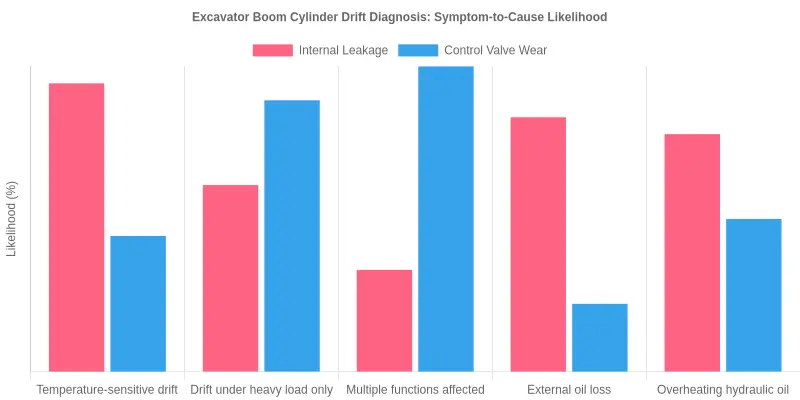
The chart compares how strongly each symptom points to one fault or the other. Temperature-sensitive drift and drift that worsens under load point to internal leakage, while drift that ignores load and shows up across several functions points to control valve wear. A dry machine with no external leak fits both faults, so it narrows the field without deciding it.
Step-by-Step Diagnostic Procedure: Distinguishing Internal Leakage from Control Valve Wear
When an excavator boom sags under load, the cause usually sits in worn seals inside the cylinder or a leaking spool in the control valve. The two faults produce similar symptoms, so guessing wastes time and parts. The procedure below walks maintenance professionals through a structured internal leakage test sequence that separates cylinder problems from control valve wear diagnosis. Work through the steps in order and record each reading.
- Perform a boom cylinder drift test with the engine off. Raise the boom to a fixed working height, hold the load, and shut down the engine. Wait a few minutes for oil to settle before you take your first measurement.
- Measure drift over a fixed time. Mark the cylinder rod or use a magnetic reference point, then record travel in millimeters over a set interval, typically 5 to 10 minutes. Consistent, steady movement points toward leakage somewhere in the circuit.
- Check for external leaks and note oil temperature. Inspect rod seals, fittings, and hoses for weeping, and log hydraulic oil temperature. Cold oil drifts differently than hot oil, so temperature must be stable before you trust any number.
- Isolate the cylinder with a load-holding test or gauges on both chambers. Cap the lines or install pressure gauges on the rod and bore sides. If the boom still settles with the cylinder isolated, the fault is internal to the cylinder.
- Check for pressure decay at the control valve with the spool centered. With the engine running and the spool in neutral, watch both gauges. A drop in pressure on the loaded side while the cylinder is isolated indicates the valve is passing oil internally.
- Run a case drain or bypass flow test on the cylinder. Measure return flow from the case drain port against the manufacturer’s allowable limit. Flow above specification confirms worn piston seals or scored bore surfaces.
- Compare every result against OEM specification. Use the service manual figures for drift rate, pressure decay, and case drain flow to confirm which component has failed before ordering parts.
Documenting results matters as much as the test itself. Record oil temperature, drift distance, gauge pressures, and case drain volume for each step, along with the machine hours and date. That written baseline turns a single diagnosis into a reference point for future checks and gives whoever rebuilds the cylinder or valve a clear picture of what was measured.
A Simple Decision Flow for Isolating Boom Cylinder Drift
The schematic maps the logic a technician follows when a boom cylinder starts drifting. Read it top to bottom and left to right: each rectangle is a check or an action, each diamond is a yes/no question, and each arrow is the answer that sends you down a different path. The guide underneath walks through every stage it represents.
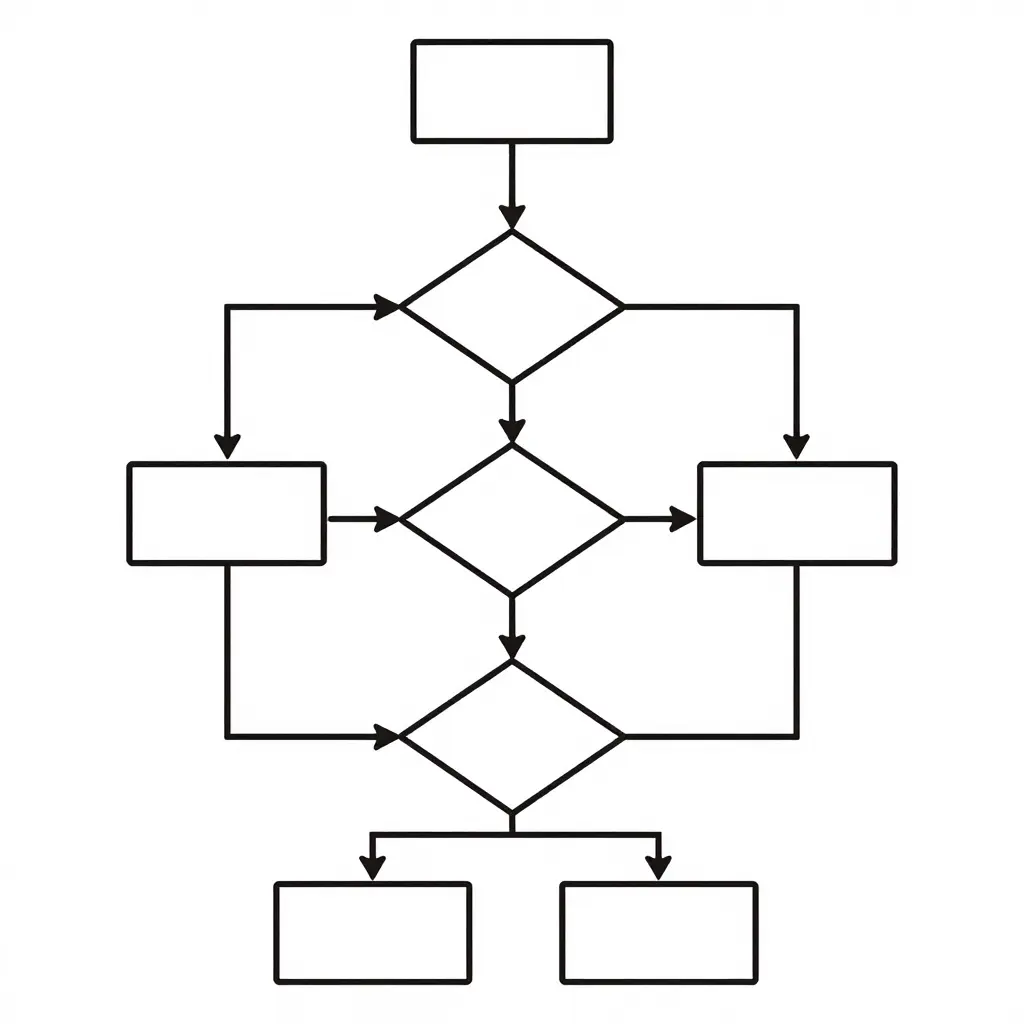
Stage 1: The starting point
The box at the top represents the starting condition: a machine parked with the boom raised and a drift already confirmed by the operator. From there a single arrow drops into the first diamond, where the questioning begins. Before chasing anything internal, confirm the symptom is repeatable and note how far and how fast the boom settles.
Stage 2: Are there external leaks?
The first diamond asks the simplest, cheapest question first. Inspect the rod seals, port fittings, hoses, and cylinder body for weeping oil, wet dust lines, or drips. If fluid is escaping to the outside, the leak is external and you reseal or replace the offending part; a straight arrow carries that branch to a repair outcome. If the machine stays dry, the answer routes you to the second branch, where the diagnosis gets interesting.
Stage 3: Is the drift temperature-sensitive?
The second diamond examines behavior rather than hardware. Does the drift stay the same whether the oil is cold at startup or hot after a full shift? A drift that grows noticeably worse as the oil warms points toward internal leakage, because thin hot oil slips past worn piston seals and scored bore surfaces far more easily than cold oil. A drift that stays constant regardless of temperature nudges suspicion toward the valve spool instead.
Stage 4: Are multiple functions affected?
The third diamond widens the lens beyond the boom. Bring the stick, bucket, and travel circuits into the test. If two or more functions drift or sag together, the problem is unlikely to sit in one cylinder bore and is more consistent with wear in the control valve, where shared spool landings have lost their sealing edge. If the boom alone misbehaves while every other function holds firm, the fault points back at that single cylinder.
Reaching the two outcomes
The two boxes at the bottom are the destinations. The left-hand outcome is internal leakage: fluid bypassing the piston inside the boom cylinder, confirmed by temperature sensitivity, a single affected function, and a hot-oil bench or cylinder leakage test. The right-hand outcome is control valve wear: spool and bore clearances opening up, confirmed by drift that ignores temperature and by several functions dropping together. Treating the wrong one wastes time and parts, so let every diamond narrow the field before committing wrench to bolt.
Putting the flow to work
Run the sequence in order, resist the urge to skip straight to a cylinder reseal, and record the answers at each diamond. The pattern that emerges, not any single reading, is what separates a worn piston seal from a tired control valve. Done methodically, this short flow turns a vague “the boom won’t hold” complaint into a confident, parts-in-hand repair plan.
Cost, Downtime, and Operational Impact of Boom Cylinder Drift
Hydraulic drift rarely stays a minor annoyance. When the boom sinks under load, productivity drops, and every hour the fault continues adds downtime. The financial consequences fall into two buckets: the repair bill itself and the indirect cost of a machine that cannot hold grade, cycle quickly, or work safely near crews.
Internal leakage and valve wear produce the same symptom but different cost profiles. Worn seals and scored cylinder bores push up the boom cylinder repair cost through seal kits, rod and bore resurfacing, and the labor to remove and reseal the barrel. Valve wear usually means a control valve repair: spool and bore inspection, metering checks, and sometimes an entire valve section.
Comparing the two repair paths
| Repair path | Typical downtime | Parts involved | Main cost drivers |
|---|---|---|---|
| Reseal cylinder | 6-10 hrs | Seal kit, rod wiper, bushings | Labor to remove barrel, cleaning, seal quality |
| Replace cylinder | 1-2 days | Complete cylinder assembly | Component price plus freight and handling |
| Control valve repair | 8-12 hrs | Spools, seals, springs, check valves | Precision machining, bench testing, contamination cleanup |
| Replace valve section | 1-3 days | New or rebuilt valve section | Section/module cost and system recalibration |
The table shows why resealing is usually the cheapest entry point and why full replacement or a valve-section swap costs the most.
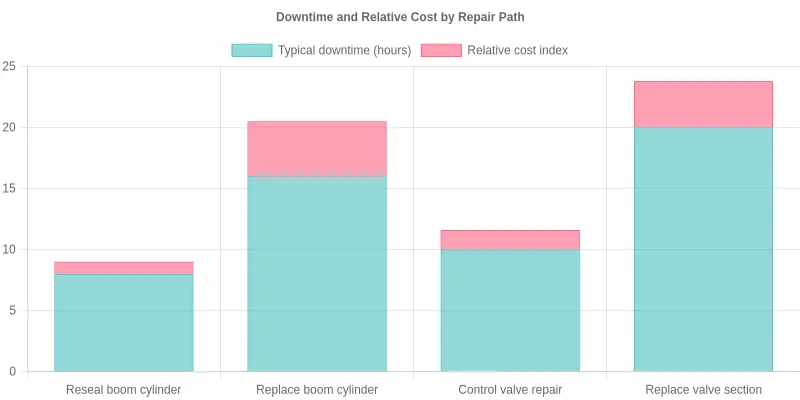
Why misdiagnosis costs more
Misdiagnosis is the most expensive habit in hydraulic troubleshooting. If a technician assumes hydraulic drift is a seal problem and reseals a healthy cylinder, the real valve wear remains untouched; the drift returns, and the team pays for the same downtime twice. Replacing a valve section when the cylinder is at fault wastes a costly component and leaves the true leak in place.
Confirming the root cause first – through pressure and flow testing, leak-down checks, and isolating the cylinder from the valve – targets the correct repair on the first attempt. A one-hour diagnostic session is far cheaper than a second teardown, a second round of parts, and another unplanned outage.
- Direct parts cost: seal kits are inexpensive; cylinders and valve sections are not.
- Labor hours: resealing and valve repair cost less in labor than full replacement.
- Excavator downtime: each day off-hire adds lost production, rental replacement, and schedule slippage.
- Rework risk: the wrong repair doubles parts spending and prolongs the outage.
- Safety and productivity loss: drift degrades control, raising risk and slowing cycle times.
- Diagnostic investment: confirming the root cause first avoids repeat failures and wasted components.
Excavator Boom Cylinder Drift Causes: Root-Cause Distribution
Tally drift complaints across a fleet and the picture is rarely a single villain. In field diagnostics, more than a third of all cases trace back to internal leakage – worn piston and rod seals that let oil slip past the cylinder. Control valve wear comes in second, followed by load-holding valve faults, contamination damage, and mixed causes. The doughnut chart below breaks down the share of each root cause so you can prioritize your inspection checklist.
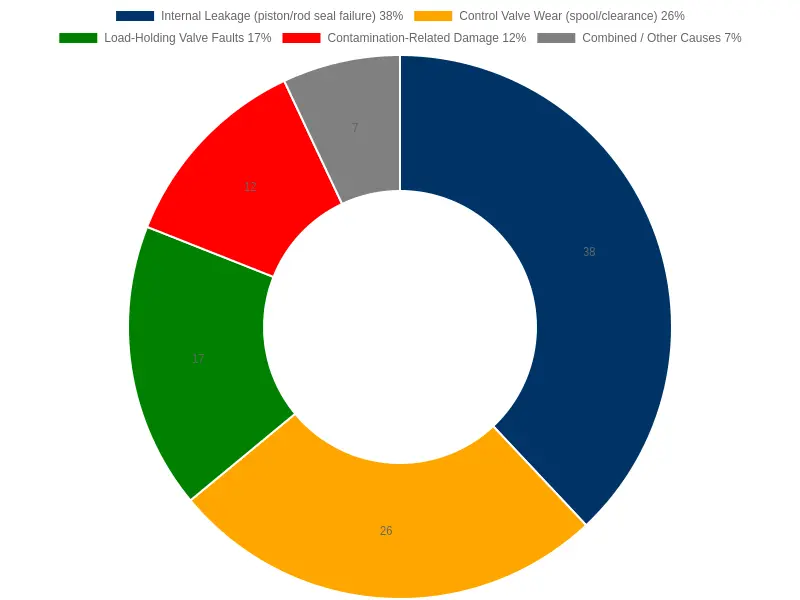
Internal leakage is the most common single cause, but it accounts for well under half of all cases. Roughly one in four drifting booms is a control valve wear problem, and a meaningful share involves the load-holding valve or contamination. That is why throwing parts at a drifting cylinder – usually a fresh seal kit – fails so often: if the real fault is in the valve, the new seal buys a month before the boom sags again. Diagnose the whole circuit before you order anything.
Preventive Maintenance and Best Practices
Stopping boom cylinder drift before it starts is cheaper than repairing it after a failure. Well-run fleets treat hydraulic care as a routine habit rather than a reaction to breakdowns. A disciplined hydraulic maintenance program lowers the two most common causes of drift: internal leakage and control valve wear. Established equipment manufacturers such as Zoomlion emphasize fluid cleanliness and scheduled hydraulic inspection in their service guidance, and the same focus applies to any brand of excavator on a jobsite.
Core Practices That Reduce Drift Risk
- Keep hydraulic fluid clean. Contaminated fluid is the single biggest driver of both seal damage and spool scoring. Use high-efficiency filtration, service breathers regularly, and store oil in sealed containers to support internal leakage prevention.
- Monitor oil condition and temperature. Test fluid at scheduled intervals, watch for varnish, water, and particulate buildup, and keep operating temperatures within spec. Sustained overheating degrades seals and accelerates wear.
- Follow seal replacement intervals. Replace seals on schedule even when they still look serviceable. Timely boom cylinder seal replacement restores sealing force and prevents slow internal leakage from becoming total failure.
- Inspect the control valve spool and load-holding valve. Check for scoring, sticking, and debris on the spool and verify load-holding valve function. These checks are essential for control valve wear prevention.
- Avoid sustained overload. Operators should use smooth, moderate control inputs, avoid holding the boom against a load for long periods, and let the hydraulics rest instead of pushing past rated capacity.
- Use OEM-quality seals and components. Aftermarket parts of unknown tolerance can wear prematurely; genuine or equivalent OEM parts help match original clearances and materials.
Following these steps keeps hydraulics tight, extends component life, and keeps machines productive instead of parked for repairs.
Frequently Asked Questions About Excavator Boom Cylinder Drift
How much boom drift is normal?
A small amount of excavator boom cylinder drift is normal. Most manufacturers consider drift of roughly 1 to 2 inches (25 to 50 mm) per hour acceptable when the boom is holding a load at operating temperature. If the boom sinks noticeably faster, or keeps moving within just a few minutes, internal leakage or a worn control valve needs attention.
Is internal leakage always caused by a bad cylinder?
No. Worn piston seals and scored cylinder walls are common causes, but the control valve spool can also leak internally as it wears. Test both components before replacing parts.
Can a worn control valve cause drift in only one function?
Yes. Because each spool is a separate moving part, only the circuit that sees the most use, such as the boom, may develop enough leakage to cause visible drift. Drift limited to a single function is a useful clue during boom drift diagnosis.
Does oil temperature affect boom cylinder drift?
Oil temperature has a strong effect on drift. Cold hydraulic oil is thicker and leaks past seals more slowly, while hot oil becomes thin and slips past worn components more easily. That is why many operators notice drift getting worse after the machine has run for a while.
How do I confirm whether the cylinder or the control valve is at fault?
A methodical boom drift diagnosis separates these two suspects. First, cap and plug the cylinder ports and load the boom to see if it still drifts; if it does, the cylinder is leaking internally. If the cylinder holds, the control valve is the likely source, and a flow meter test can confirm wear in the spool.
Can contaminated hydraulic oil cause both problems?
Yes. Abrasive particles wear down piston seals and spool surfaces at the same time, gradually increasing both internal leakage and control valve wear. Regular oil sampling and filter changes are the cheapest way to prevent this double failure.
Conclusion: Diagnose Before You Replace
When an excavator’s boom slowly sags under load, the root cause almost always traces back to one of two culprits: internal leakage inside the boom hydraulic cylinder, or control valve wear. The two produce nearly identical symptoms, which is why guessing is so costly. Replacing a healthy cylinder only to find the real fault in a worn control valve wastes money, parts, and working hours. Gather symptoms first, then confirm the diagnosis with structured testing before any wrench turns.
Correct diagnosis pays for itself many times over. It prevents unnecessary parts replacement, shortens downtime, and gets the machine back to productive work sooner. It also points attention at what keeps hydraulic systems healthy in the first place: routine maintenance and clean hydraulic fluid. Contaminated or degraded fluid accelerates both internal leakage and control valve wear, so fluid cleanliness is central to long-term reliability, not a side issue.
Key Takeaways
- Excavator boom cylinder drift is usually caused by either internal leakage in the boom cylinder or control valve wear, and not by a single obvious failure.
- Because both faults look alike, accurate diagnosis relies on careful symptom analysis followed by structured testing.
- Testing before repair avoids replacing healthy components and cuts unnecessary downtime.
- Routine hydraulic maintenance and strict fluid cleanliness slow down both internal leakage and control valve wear.
- A disciplined diagnostic habit protects your budget, your schedule, and your machine.